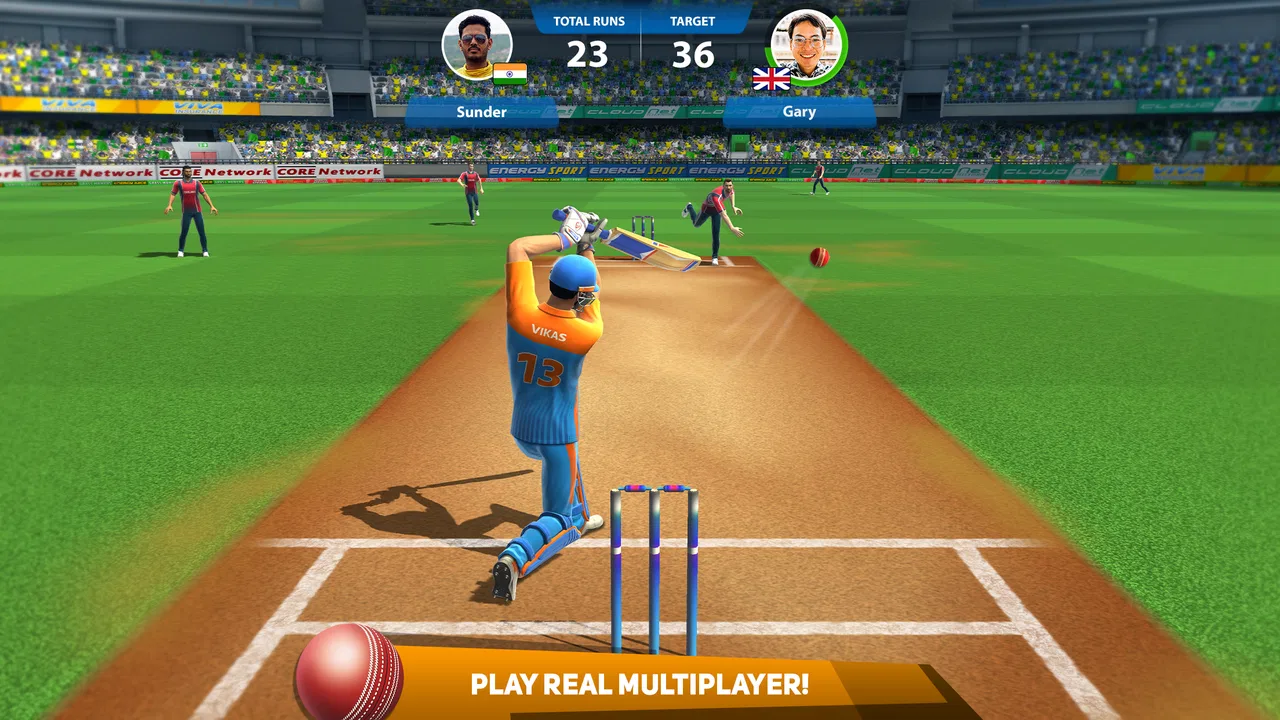
Cricket League
- 4.6
- Rating
- 100.00M
- Installs
- Free
- Price

 Analysis by App-foxy
I went into Cricket League expecting a quick cricket game for filling a few spare minutes, and that is exactly where it works best. It is a sports game from Miniclip.com built around short one-on-one matches, with batting and bowling compressed into a format that feels easy to start but surprisingly demanding to master. My overall view is simple: it is a strong choice if you want fast decisions, clear controls, and a match that does not ask for a large time commitment. It is less convincing if you want a deep cricket simulation with long innings, detailed team management, or a highly realistic representation of the sport.
The game is free to download and aimed at Everyone, which makes it approachable for casual players and younger fans alike. It has also found a very large audience, with more than 100 million installs and an average rating of 4.7 from about 3.3 million ratings. Those figures do not automatically make a game good, but they match my impression that the basic idea is immediately understandable: pick up the phone, play a compact cricket contest, and make each delivery count.
Why the short format works so well
The central appeal is the tight match structure. You are not settling in for a long cricket session; you are working through a brief contest in which every ball has a visible consequence. The game gives each side two overs for bowling and batting, so the pressure arrives quickly. A quiet opening is not harmless, and one poorly judged shot can change the entire result.
You May Also Like

 Google Keep - Notes and lists
Google Keep’s Quiet Growth Shows the Appeal of Simpler Notes
As mobile work gets busier, Google Keep keeps winning a simple contest: capture a thought quickly, find it later, and get on with the day.

 Blood Strike: 2.5 Anniversary
Blood Strike’s Loadouts Turn Every Drop Into a Tactical Gamble
A close look at Blood Strike’s custom loadouts: how fast access to signature weapons reshapes its battle royale rhythm, rewards preparation, and narrows the gap between fights.

 Pandora - Music & Podcasts
Pandora’s Music Is Easy to Start, but Harder to Recover
Pandora’s strength is its low-effort path from a seed to a station. Its weak spot is how much confidence it asks you to place in connection, setup, and quiet recovery.

 8 Ball Pool
 Is Built on Rivalries, Rematches, and Routine
A close look at the rivalries, rematches, shared routines, and unanswered safety questions that turn a quick pool match into a persistent mobile community.

 Samsung Music
’s Quiet Strength Is Playing What You Already Own
Its reach comes less from spectacle than from dependable access to a personal library. That simplicity is both the app’s strongest retention engine and its ceiling.

 AccuWeather: Weather Radar
AccuWeather Review: A Quick, Clear Forecast for Everyday Decisions
For everyday plans, the best forecast is the one you can understand quickly. AccuWeather makes rain timing, radar, and local conditions easy to act on, with a few trade-offs.
More From Our News Desk



That design makes the game especially effective during ordinary gaps in the day. I can imagine playing a match while waiting for a friend, taking a short break from work, or sitting on public transport without worrying that I will need to abandon a long innings halfway through. The short format also makes losing easier to accept. A defeat feels like an invitation to try a different approach rather than a major time investment gone wrong.
What I like most is that the limited number of deliveries gives small choices extra weight. With longer cricket games, a player can often recover from a cautious start. Here, caution has a cost because you have so little time to build momentum. At the same time, attacking every ball is not automatically smart. The best results come from reading the situation, choosing when to take a risk, and remembering that the opponent has the same compressed window in which to respond.
The controls are designed to keep the action moving rather than reproduce every technical detail of real cricket. That is a sensible decision for a mobile game, although it also explains why experienced cricket fans may find the experience lighter than a full simulation. I found the accessible approach useful at first because I could concentrate on timing and decisions instead of learning a complicated control scheme. The trade-off is that repeated play depends more on improving judgment than on discovering a large collection of advanced mechanics.
Small decisions matter more than flashy shots
A useful way to approach the game is to stop treating every delivery as an opportunity for a spectacular hit. When batting, I found it more productive to think about the remaining balls and the current score before choosing an aggressive response. A powerful stroke can be valuable, but a rushed attempt can waste one of the few chances available in the innings. In a short match, preserving control for the next delivery can be more important than chasing the biggest possible result immediately.
Bowling creates a similar tension. The temptation is to search for a dramatic delivery every time, yet variation is more effective when it has a purpose. I try to consider what the batter is expecting and then change the plan rather than simply repeating the same action. Even without turning the game into a detailed tactical simulator, that habit gives the bowling phase a little more personality and stops it from feeling like a routine exchange.
The most useful practical tip I found is to watch the opponent’s rhythm instead of focusing only on my own preferred move. If a player appears comfortable against a certain type of delivery or keeps attempting the same batting response, that pattern becomes more important than any general strategy. The short match format rewards quick observation. You do not have many opportunities to test a theory, so identifying a habit early can be more valuable than trying to execute an elaborate plan.
Another worthwhile adjustment is to treat the first few balls as information-gathering opportunities. That does not mean playing passively. It means noticing how much risk the situation can support before committing to a bigger attack. This approach is particularly helpful for new players because it turns early mistakes into lessons about timing, opposition behavior, and the cost of impatience.
A good balance between accessibility and competition
Cricket League succeeds because it gives beginners a clear starting point while leaving room for competitive improvement. I did not need a detailed understanding of cricket tactics to enjoy the first matches. The basic objective is obvious, and the short rounds make experimentation painless. If a strategy fails, I can immediately try again with a different idea instead of waiting through a long match.
At the same time, the game is not completely mindless. The limited overs create a useful layer of planning, and the one-on-one structure makes the result feel connected to my decisions. That is an important distinction from sports games that mainly rely on automatic outcomes or repetitive tapping. Here, the player has to stay alert because a small lapse can affect the whole contest.
The game is also a better fit for people who enjoy repeated attempts than for players seeking a single, complete campaign. Its appeal comes from refining reactions and choices over several matches. I would not recommend approaching it as a one-time experience. The enjoyment grows when you notice that a defeat came from a poor decision you can correct, rather than from an outcome that feels entirely random.
Compared with a traditional cricket simulator, this is much easier to enter and much faster to play. A simulator is the better option for someone who wants full innings, broader control over a team, and a more detailed sense of the sport’s structure. Compared with a generic arcade sports game, this title has a clearer identity because the two-over format gives the action a distinct rhythm. It sits between those extremes: more thoughtful than a purely casual tap game, but far less demanding than a full cricket simulation.
Where the experience loses some momentum
The same short format that makes the game convenient can also become its main limitation. After several matches, the compact structure may start to feel repetitive, especially for players who want more variety in how a cricket game unfolds. The format is excellent for quick sessions, but it naturally narrows the range of situations the game can create. There is less room for a slow build, a long recovery, or the changing momentum of a full-length innings.
I also think the accessible design may leave advanced players wanting more control. If your enjoyment comes from managing every aspect of a cricket team, planning a long bowling spell, or shaping a match over many overs, this will probably feel too streamlined. The game focuses on the decisive moments rather than the entire sport. That is not a flaw in itself, but it is a clear boundary around what the experience is trying to be.
The free-to-play structure deserves attention as well. The game costs nothing to start, but optional in-app purchases range from $0.49 to $99.99 per item. I would advise treating purchases as a personal spending decision rather than something necessary for the basic appeal. Anyone who is sensitive to optional spending should set a limit before playing, particularly because short competitive matches can encourage the thought that one more upgrade or purchase might improve the next result.
That spending model also affects who should be cautious. A player who enjoys slow, self-directed progress may be comfortable ignoring purchases. Someone who dislikes any pressure around optional items may prefer a paid sports game with a simpler structure. I would not choose this title specifically for a completely purchase-free experience, even though the free entry point is a genuine advantage.
Another limitation is that the game’s quick pace can make losses feel abrupt. In a longer cricket match, there is time to rebuild an innings and understand how the contest changed. Here, a couple of weak decisions can leave little room for recovery. I found that exciting when I was focused, but frustrating when I was distracted. This is a game that rewards attention more than passive play, even though each session is short.
How I would use it in everyday play
My favorite use case is a ten-minute break where I want something interactive but not mentally exhausting. I can play a couple of matches, test one bowling idea, and put the phone away without feeling that I have interrupted a larger story. It also works well for friendly competition because the rules are simple enough to explain quickly, while the short format makes rematches easy.
For a new player, I would start by focusing on consistency rather than trying to win every ball. Learn how the batting and bowling actions respond, then pay attention to which decisions produce reliable results. Once the basic rhythm feels comfortable, begin changing the timing and risk level according to the score. This progression is more useful than copying an aggressive style from the beginning, because the game’s limited overs punish habits that are not suited to the situation.
A second practical use is as a quick warm-up before a longer sports game. The matches are brief enough to help me get into a competitive mindset without demanding a full session. However, I would not use it as a substitute for a detailed cricket game when I want to study the sport itself. It is better at delivering concentrated excitement than at teaching the broader structure of cricket.
Parents and younger players may appreciate the Everyone age rating and straightforward presentation. Still, I would explain the optional purchase system before handing over a device, especially when the game is being played on a shared account. The age rating makes it broadly accessible, but it does not remove the need for sensible spending boundaries.
Who should choose it, and who should skip it
I recommend it to casual sports fans, cricket newcomers, and players who prefer short competitive rounds. It is particularly suitable for someone who wants a game that can be understood quickly but does not become completely automatic after the first attempt. If you like making fast choices under pressure and learning from repeated matches, the compact structure should suit you well.
I would also suggest it to fans who enjoy cricket but do not have the time or patience for a full simulation. The game captures the urgency of a close contest without asking for a long session. Its strongest quality is not realism in every detail; it is the way it turns a small number of deliveries into a focused challenge.
I would skip it if your priority is comprehensive team management, long-form match progression, or maximum control over every cricketing detail. I would also be cautious if you find short competitive games stressful rather than entertaining. The limited overs mean that mistakes are magnified, and the rapid rematch loop can encourage repeated attempts even when you are no longer enjoying yourself.
The current version is 1.32.0, and the game supports devices running Android 6.0 or later. That makes it accessible to people using older Android hardware, although the actual comfort of play will still depend on the phone’s screen, responsiveness, and general performance. I would favor a device with a responsive touch display because timing matters more here than raw visual spectacle.
My final recommendation
Cricket League is at its best as a focused, fast cricket game rather than a complete cricket simulation. The two-over structure gives every delivery importance, the controls are approachable, and the one-on-one format makes it easy to play a match whenever a few spare minutes appear. I especially like that the game rewards observation and restraint instead of making constant aggression the only path to success.
Its weaknesses are equally clear. The compressed format can become repetitive, advanced cricket fans may miss deeper control, and the optional purchase range means players should approach the free-to-play model with a spending plan. Those points do not cancel out the game’s strengths, but they should shape expectations before downloading it.
For me, this is a recommendation with a specific purpose: choose it when you want quick cricket matches, immediate competition, and enough tactical pressure to make short sessions feel meaningful. If that sounds like your kind of sports game, Cricket League is easy to recommend. If you want the full patience, planning, and detail of real cricket, look elsewhere for a more substantial simulation.
FAQs for Cricket League
01What is Cricket League and what does it offer?
Cricket League is a fast-paced, multiplayer cricket game that offers users a chance to enjoy quick matches with players worldwide. It features various modes, including tournaments and one-on-one games, allowing players to experience the thrill of cricket on their mobile devices. With its intuitive controls and engaging gameplay, it's perfect for both cricket enthusiasts and casual gamers.
02Is Cricket League free to play, and are there in-app purchases?
Yes, Cricket League is free to download and play. However, it offers in-app purchases that allow players to enhance their gaming experience. These purchases may include cosmetic upgrades, new player kits, and faster progression options. It's important for players to keep this in mind to manage their spending within the app.
03What devices are compatible with Cricket League?
Cricket League is available on both Android and iOS platforms, making it accessible to a wide range of devices. To ensure optimal performance, it is recommended that players have a device running Android 5.0 or iOS 10.0 and above. Check the app store for specific device compatibility before downloading.
04Does Cricket League require an internet connection to play?
Yes, Cricket League requires a stable internet connection to function as it is primarily a multiplayer game. The online connectivity allows players to compete against others globally and participate in live tournaments. While some features might be accessible offline, the core experience is best enjoyed online.
05How can players improve their skills in Cricket League?
Players can enhance their skills in Cricket League by practicing regularly and participating in various game modes. The game offers tutorials and practice matches that help players familiarize themselves with the controls and strategies. Engaging in tournaments and friendly matches can also provide valuable experience and improve gameplay.
Pros
- Smooth and intuitive gameplay mechanics.
- Wide variety of teams and players.
- Quick match options for short play.
- Engaging graphics with vibrant visuals.
- Regular updates with new content.
Cons
- Limited customization options for teams.
- Occasional in-app purchase prompts.
- Requires stable internet connection.
- Matchmaking can be uneven at times.
- Some ads can be intrusive.

Cricket League
Gallery